 Elliott Cheeks
You Already Manage an AI
Prompting, examples, review: you learned all of it the first time you delegated. AI fluency is management fluency with a shorter feedback loop.
The most common thing I hear from smart, senior people about AI is some version of "I'm not technical enough for this."
Here's what's strange about that sentence: the people saying it usually run teams. They delegate for a living. And delegation is the entire skill.
You've done this before
Think about the last time you handed real work to a new employee. You did five things without thinking about them:
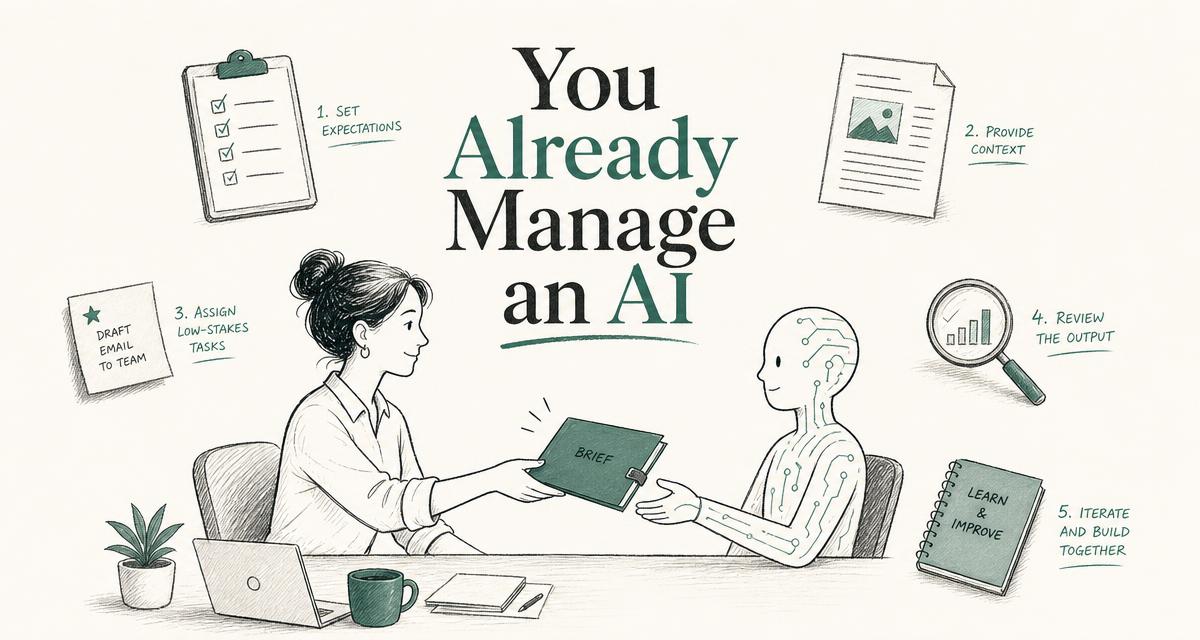
You gave clear instructions, including the context they'd need. You showed them an example of what good looks like, probably a past deliverable. You started them on something low-stakes, not the board deck. You checked their output before it went anywhere that mattered. And over a few weeks, you built a mental map of what you could hand them cold and what still needed your eyes.
That is, item for item, the discipline of working with AI. Prompting is instructions. Few-shot examples are the sample deliverable. Task selection is the low-stakes start. Review is review. The mental map is the same map.
The people struggling with AI aren't failing at technology. They're skipping management steps they would never skip with a person.
Watch how a frustrated first-timer actually uses these tools. They hand a stranger the most important task of the week, on day one, with a one-line instruction and no example. They get a mediocre result and conclude the stranger is useless. No manager operates that way, because every manager knows what happens when you onboard someone that badly. It's not the hire that failed.
Where the parallel breaks
The analogy is load-bearing, so let's be honest about where it snaps. Three places:
It forgets. A new hire compounds; by month three they know your business. An AI session starts from zero every time unless you engineer the memory yourself, by writing down context, standards, and past decisions and handing them back at the start of each task. The sharpest new hire you've ever had, with the shortest memory you've ever seen. Plan for it and it's a quirk. Ignore it and every day is day one.
It never gets embarrassed. A person who ships a bad number to a VP feels it and self-corrects. An AI feels nothing. Whatever pressure keeps quality up has to live in your process, a check the output must pass, not in the tool's pride, because the tool has none.
It never pushes back on scope. A good employee says "that deadline isn't real" or "you're asking the wrong question." AI mostly attempts whatever you ask, confidently. The judgment your best people apply before the work starts is now entirely your job.
Notice the pattern in all three breaks: nothing about them is technical. They're management adjustments. Which is the point.
The onboarding plan
If a new hire deserves an onboarding plan, so does this. The one I actually run:
-
Write the job description. One paragraph: what this task is, what the input looks like, what a finished output looks like, what it must never do. If you can't write it, you're not ready to delegate it, to anyone.
-
Hand over an exemplar. Your best past version of the deliverable. "Match this" outperforms three paragraphs of adjectives every time.
-
Start below the waterline. First assignments should be work where a wrong answer costs you a shrug, not a customer: internal summaries, first drafts, research legwork.
-
Check everything, then check samples. Early on, review every output against something you know is true. As a task proves itself, drop to spot-checks. The promotion is earned per task, not granted to the tool.
-
Keep a record. What did you hand it, what came back, what needed fixing. Two weeks of this and you have the same map you'd have of any employee: brilliant here, shaky there, never unsupervised over there.
That's the whole system. No API keys, no coursework, no vocabulary test.
The reframe
"Am I technical enough for AI" is the wrong question, and it keeps capable people on the sidelines while they wait for a course to make them feel licensed.
The right question is one you already know how to answer: am I a good enough delegator to get value out of a fast, tireless, forgetful new hire?
If you've built a team, you are. You've done this before. It just had a different name.
Verified in this piece: no production figures used; the onboarding plan is the artifact. Next in this series: How It Fails, Not How It Works.
I ship AI-built software into production and write about the gates, patterns, and cost discipline that make it work. More about me →
Practitioner notes on the gates, the patterns, and the cost discipline behind AI-built software.
Related reading
Seven gates, each one blocking the next. Most projects should die at Gate 1, and the ones that survive all seven are the ones people actually trust.
Jargon is a tax you pay in stakeholders. Plain language isn't dumbing it down; it's the half of deployment nobody budgets for.